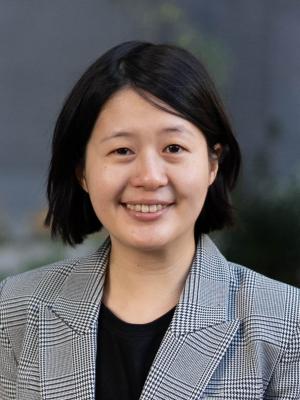
Tzu-Hsin Karen Chen, PhD, MS
About
Dr. Tzu-Hsin Karen Chen is an assistant professor in DEOHS, the Department of Urban Design and Planning, and the Data Science program. She studies large-scale urban environmental change and its implications for public health and health inequality. Her research uses machine learning, satellite imagery, and street views to quantify built, social, and physical environmental characteristics, as well as natural language processing and AI to understand the landscape of psychological well-being.
Currently, Dr. Chen is leading two projects: one exploring the relationship between urban planning and mental health during extreme weather events, and the other investigating the intersection of urbanization and climate-related hazards, such as extreme heat, landslides, and wildfires. Her studies often environmental justice, vulnerability, policy intervention, through working with interdisciplinary and regional collaborators, including the Mediterranean region, the Himalayas, and the United States.
Dr. Chen’s expertise has earned an Early Career Award from NASA's Earth Science Division (2024-2027), as well as her recognition as one of the Leading Women in Machine Learning for Earth Observation in 2022. Her research findings have been published in Science Advances, Remote Sensing of Environment, Journal of Land Use Science, Applied Geography, and Science of the Total Environment, among others.
Prior to joining UW in 2023, Dr. Chen studied internationally in Taiwan, Denmark and Germany and conducted her postdoctoral research at Yale University. She is passionate about making research engaging and accessible to broader audiences. She also believes that fostering diversity and inclusiveness is essential for achieving academic excellence. In her leisure time, she enjoys spending time with cats and taking walks in the woods.
Education
- PhD, Environmental Science, Aarhus University, 2020
- MS, Geography, National Taiwan University, 2016
Affiliations
Mentorship
Research
Dr. Chen is leading two current projects. One explores the relationship between urban form, outdoor activities and mental health. The other investigates the intersection of urbanization and climate-related hazards, such as flooding, extreme heat and landslides. Utilizing geospatial and remote sensing techniques, her studies span large-scale investigations and work with regional collaborators, including in the Mediterranean region and the Himalayas.
Publications
Selected publications
- Higher depression risks in medium- than high-density urban form across Denmark
- Detecting subpixel human settlements in mountains using deep learning: A case of the Hindu Kush Himalaya
- Mapping horizontal and vertical urban densification in Denmark with Landsat time-series from 1985 to 2018: a semantic segmentation solution
- Residential environments across Denmark have become both denser and greener over 20 years
- Detecting and monitoring long-term landslides in urbanized areas with nighttime light data and multi-seasonal Landsat imagery across Taiwan from 1998 to 2017
Engagement
Equity, diversity and inclusion
In my journey as a geographer, I have been deeply drawn to the exploration of inequality as a central focus of my research. One of the key questions that motivates me is understanding why mental disorders exhibit varying prevalence across different areas. To unravel this complex issue, I recognize the need to go beyond psychological mechanisms and delve into the socio-economic factors at play. Thus, I believe that learning about difference and commitment to diversity, equity and inclusion in universities and our society is crucial to excellence.
I am also committed to reducing career barriers for underrepresented groups in environmental health science. As an international scholar and a former member of Yale's LGBTQ+ affinity group, I served as a panelist for +the career mentoring session of Justice, Equity, Diversity and Inclusion (JEDI) at the American Association of Geographers' annual meeting. My commitment to promoting gender equality is reflected in my publication on gender inequality in urban land science and my role as a panelist for Women in Remote Sensing discussions, where I addressed the leaky pipeline of women scientists and advocates for gender equality in practice. As a mentor, I strive to create an environment where all feel empowered to share their experiences and ideas.
Teaching practices
I am co-teaching Public Health and the Built Environment. Students learn how health outcomes are linked to people's living environments. Many supporting environmental factors, including greenspace, are disproportionately lower in Black and low-income neighborhood in the US, while cultural contexts can be different in other countries. Open discussion and shared responsibility are encouraged and fostered.
Service
Teaching in the Data Science minor.
Member, Center for Studies in Demography and Ecology (CSDE)
Member, eScience Institute