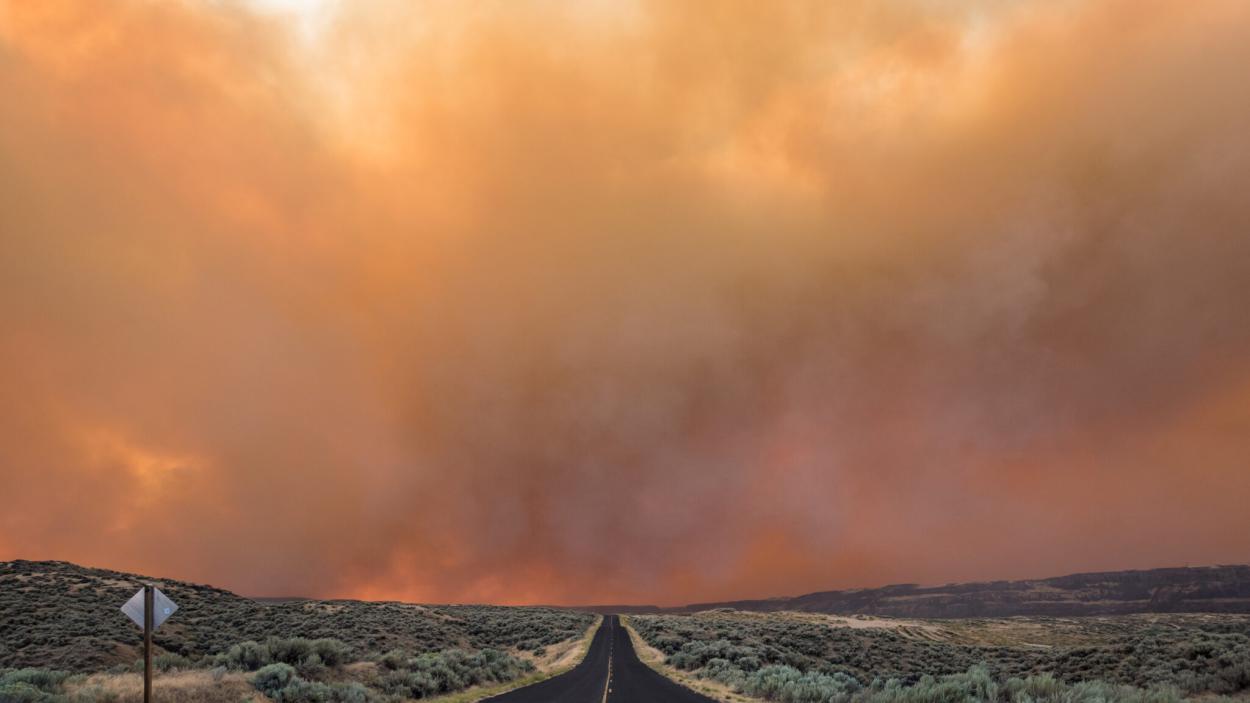
Nobody is immune from the hazards of summer wildfires, even the experts. At the University of Washington, researchers study both how to mitigate and understand wildfire behavior and how air quality degrades as a result of burning blazes. While UW faculty contribute to a rapidly emerging body of research into the risks of fire and smoke season, they also contend with the decisions that the rest of us face: how to protect themselves and their families, where to find reliable information, and how to manage the anxieties of summer smoke.
Who better to learn from? As fires rage and smoke smothers the Pacific Northwest — including historic and devastating blazes in Spokane — UW News sat down with five UW experts in fire science, forestry, air pollution and more to ask how they manage wildfire season.
Do you have an air quality index (AQI) threshold where you’re no longer comfortable being outside? Does that vary depending on what you’re doing outside? If so, how?
Edmund Seto, professor of environmental and occupational health sciences: The AQI is designed for communicating health risk to both general populations as well as populations that may be more susceptible to smoke. Rather than focusing on the AQI number, I instead focus on the public health messaging (the “Description of Air Quality” column in the U.S. Environmental Protection Agency's table guide).

Elena Austin, associate professor of environmental and occupational health sciences: I generally become more concerned when air quality has remained consistently elevated for about 24 hours, because I think about smoke exposure cumulatively over the course of the day.
Susan Prichard, research scientist in environmental and forest sciences: If it looks like air quality is going to degrade over an AQI of 80, I start thinking about my health and what level of activity I’m going to do. As the science on smoke and human health only becomes more cautionary, I save strenuous exercise like running or climbing mountains for times when the AQI is below 80.
If you have to be outside during smoky days, how do you protect yourself?
Ernesto Alvarado, research associate professor of environmental and forest sciences: Starting from AQI in the yellow zone, I may wear a N95 mask. However, above the orange zone, an N95 mask is mandatory.
ES: If working outdoors during smoky days, you and your employer should be aware that in Washington State, Labor and Industries has established rules to protect workers from hazardous smoke exposures. Also be aware that oftentimes smoke and heat co-occur, and there are heat exposure rules for working outdoors too.
E. Austin: I always make contingency plans while hiking and camping. In that case, I identify egress routes prior to departing in case a wildfire event limits my ability to return using the route I had planned. I also sign up for emergency text alerts for the county where I am spending time, and check the current fire activity and nearby evacuation status.
How do you keep your indoor spaces safe during smoke waves?
ES: Thinking ahead and preparing your indoor space for regularly occurring wildfire smoke episodes is just as important as planning for other emergency events. Can you close doors and windows tightly and have good weather sealing to avoid smoke from infiltrating indoors? Can you set your ventilation system to recirculate air? Have you replaced your ventilation system (e.g., furnace) filter recently? Have you considered getting a portable HEPA-rated air cleaner that is sized appropriately for your bedroom or living area? Have you considered building a DIY box-fan filter?

E. Austin: I create a smoke-ready space in my home. This is a separate area, where I set my ventilation system to recirculate indoor air rather than bringing in outdoor air. I also run a HEPA filter, rated to perform well for the square footage of my space, during wildfire events. Lastly, I try to reduce air exchange between the indoor space and outdoors by closing all windows, only opening outdoor doors when necessary, and weatherizing the space around doors and windows prior to the event.
SP: For indoor air, we make sure our HEPA air filters are clean at the end of each fire season so that they are ready to go the following year. When there’s smoke in the air, we make sure windows and doors are closed and use our air filters. We also just got a heat pump so that we can keep windows closed when smoke is a factor at night.
How do you manage the stress and anxiety of fire season both here and elsewhere?
E. Austin: I manage that stress by preparing my home before fire season, relying on a small number of curated information sources rather than trying to identify reliable sources in the moment or checking multiple apps, and I try to make flexible backup plans for outdoor activities. I also suggest planning ahead to learn how to obtain and effectively use an N95 respirator to reduce exposures either at work or when outdoors for recreational activities.
SP: Fire and smoke season are stressful. I’ve dealt with some stress and anxiety not only from fast-moving wildfires but also from long-duration smoke events that feel like they will never clear. We have a strong community that is very supportive and understands how fire season can bring up some PTSD-type symptoms. We take care of our place and make sure that we have as low of risk in and around our home as possible. We also remind ourselves how very lucky we are to be able to have flexibility in our work schedules and plenty of friends and family elsewhere to be able to leave when wildfires hit close to home.
BH: Fire is an integral part of life on earth, and in regions like the Pacific Northwest, fire is a key process that will continue to shape this region well into the future. Knowing that it is not if, but when, fire will return to any given area helps me embrace the reality of fire season. Like anything in life, being informed and prepared is a great way to lower stress and anxiety that comes with uncertainty.
The UW has dozens of experts in wildfires, smoke and related topics. To reach an expert, contact Alden Woods at acwoods@uw.edu.
Excerpted from the full Q&A at UW News.